Cartwright Hall Art Gallery

Splendours of the Subcontinent: Enameled Salver

February 27, 2017

This week’s ‘Splendours of the Subcontinent‘ linked post from the Royal Collections Trust is written by Kajal Meghan.

She writes:

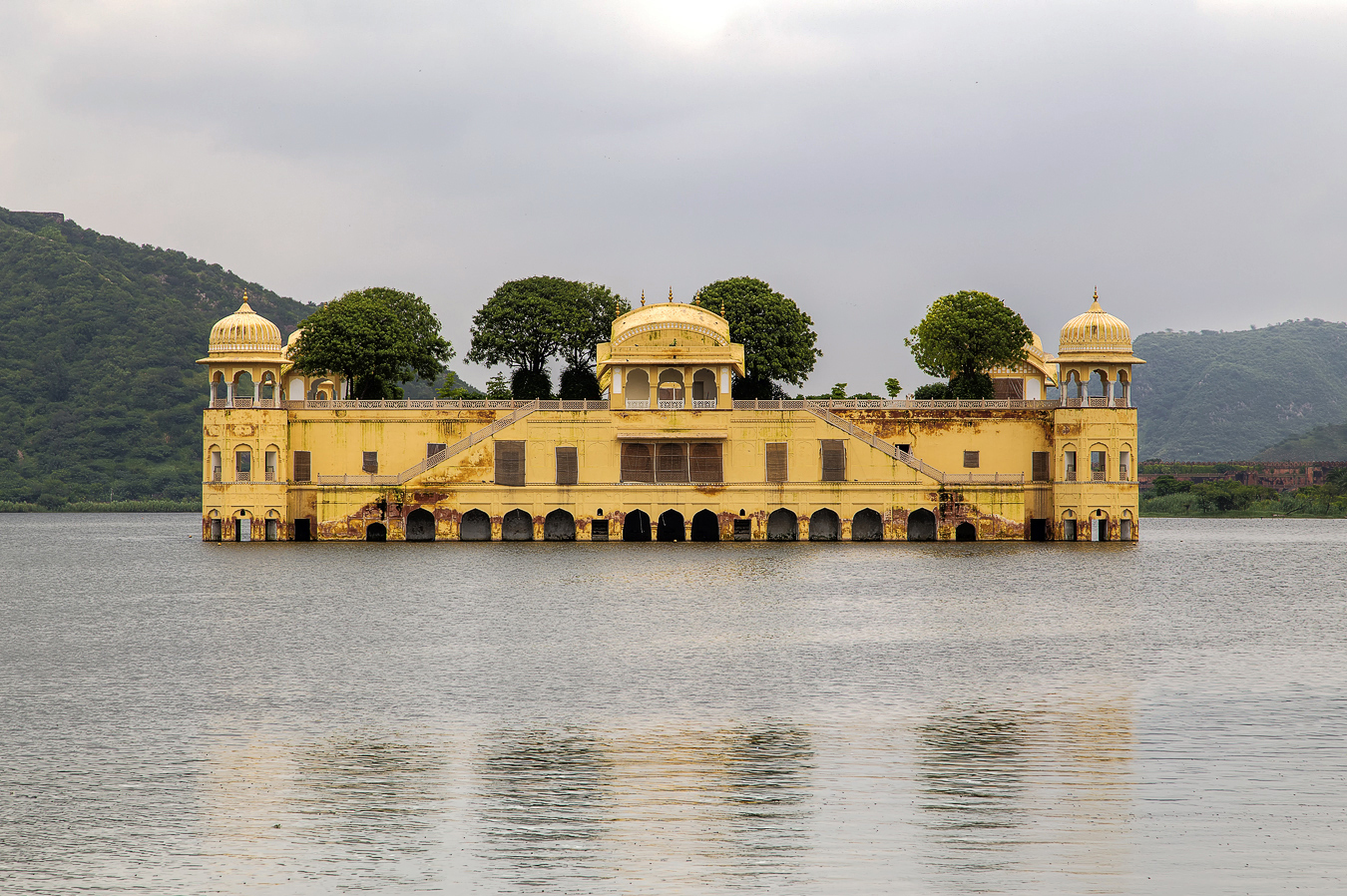
Following our last post on the Prince of Wales’s time in Jaipur, this article explores one of the beautiful gifts that the Prince received as a memento of his visit to the city in 1876. This gold salver, enamelled with intricate patterns of animals and flowers, features roundels depicting the Chandra Mahal and the Jal Mahal, two of Jaipur’s famous palaces.
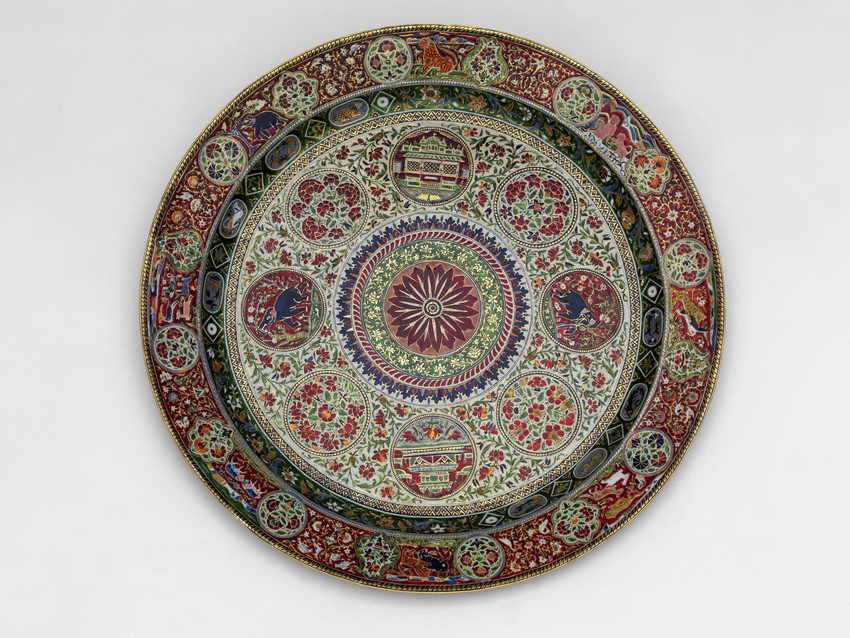
Caption: Enamelled gold salver (RCIN 11469). Copyright: Royal Collection Trust/© Her Majesty Queen Elizabeth II 2017
Enamelled gold salver (RCIN 11469). Copyright: Royal Collection Trust/© Her Majesty Queen Elizabeth II 2017

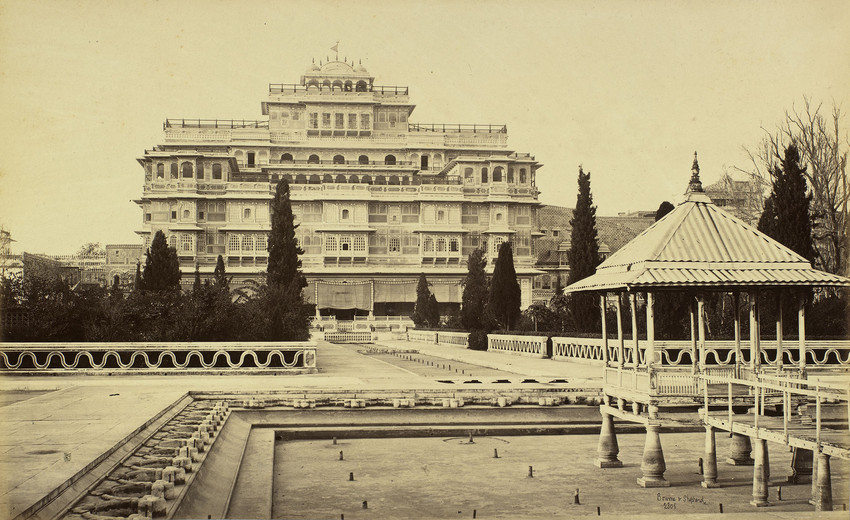
The Chandra Mahal, meaning ‘Moon Palace’, can be seen in the top roundel on the salver. It was built in the eighteenth century and is made up of seven storeys. Today the palace contains the Maharaja Sawai Man Singh II museum and the private apartments of the current Maharaja of Jaipur.

: detail of salver (RCIN 11469). Copyright: Royal Collection Trust/© Her Majesty Queen Elizabeth II 2017
 detail of salver (RCIN 11469). Copyright: Royal Collection Trust/© Her Majesty Queen Elizabeth II 2017
Nineteenth century photograph of the Chandra Mahal (RCIN 2701829). Copyright: Royal Collection Trust/© Her Majesty Queen Elizabeth II 2017.

The Jal Mahal, meaning ‘Water Palace’, is located in the middle of Man Sagar Lake. Today, only the top storey of five is visible.  Most of the eighteenth century palace is submerged below an artificial lake.

detail of salver (RCIN 11469). Copyright: Royal Collection Trust/© Her Majesty Queen Elizabeth II 2017.
Jantar Mahal Copyright: Firoze Edassery

The technique of enamelling had been introduced in India in the late sixteenth century by European craftsmen based in Portuguese Goa. The Mughal emperor Akbar (r.1556–1605) sent his court craftsmen to learn this technique which later spread to the nearby courts of Rajasthan. Enamelling embellished a range of objects such as jewellery, vessels and swords. An enamelled object, such as this salver, would usually require the work of several craftsmen: a designer who would come up with a design based on pattern books, a goldsmith who would form the object out of gold, an engraver who would incise the pattern onto the surface and an enameller who would apply the colours. Each colour would need to be carefully applied and fired separately. This particular salver was enamelled by Ram Singh, one of the leading enamellers of the time, and took four years to make.

Enamels from Jaipur were very popular amongst Europeans visiting or living in Jaipur, and they were often presented as gifts to visiting dignitaries. These works were praised for their richness in colour, delicate workmanship and intricate design. William Howard Russell, writer of the official tour diary, went as far as to say that ‘all the best workmen in London, Paris, Vienna and Rome admit they cannot match this wonderful work!’

Leave a Reply

Your email address will not be published. Required fields are marked *

News and Blogs from Bradford District Museums & Galleries

Sports clubs, community groups and local history enthusiasts are invited to help bring Keighley's sporting heritage to life at Cliffe Castle Museum's Heritage Open Day on Sunday 13 September 2026. The museum is seeking displays, talks, activities and stories celebrating the sports and pastimes that have shaped local life through the years.
Maleeha Amin has seen first hand how museums can bring people together through inclusion, creativity and representation. From exploring the role of Makaton in making cultural spaces more accessible, to volunteering with local communities and celebrating South Asian artists' voices at Cartwright Hall, she reflects on the small changes and meaningful conversations that help make Bradford's heritage spaces welcoming for everyone.
Khadijah Ali reflects on her journey from volunteering to being appointed as a Lead Museum Young Ambassador.
Our museums are continually evolving as new research, perspectives and community voice deepen our understanding of the past.

Related News and Blogs from Bradford District Museums & Galleries