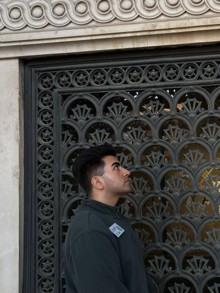
Written by Usman Javaid, one of the young people behind The Portait of Us
Being a part of the “Portrait of Us” Exhibition truly allowed me to tap into a part of myself I hadn’t given the chance to grow. The creative, artistic and intrinsic part of me. I had always had a natural pull to art, and over time, I had shaped my mind’s eye to see what visually spoke to me.
One of the pieces that spoke to me is “The Zone of Dreams”.
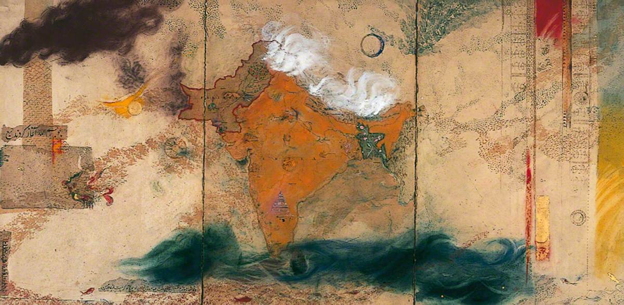
The title itself has so many connections to Bradford and Cartwright Hall. With Bradford being the City of Dreams, the dreams of Grandparents and those before us wishing better for their children. In my case, these dreams started in the South Asian Sub-Continent.
The three countries you see, Pakistan, India and Bangladesh, are all visible clearly with lines of demarcation showing you that they are separate entities. Independent of one another. However, taking a step back, you can see the outline of all 3 countries and can see what they look like altogether. This mimics the history of the area itself, from being interconnected and whole before the colonisation of the subcontinent to now, where the subcontinent is divided beyond the border lines.
Looking at the countries, they feel a world away from where I am right now in Bradford. But each individual country is also a world away from the others. Too often, the global West clumps together the subcontinent, forgetting that each culture is different and unique in its own right.
Focusing on the use of colour, looking at the use of orange, which is deeply intertwined with the Hindu and Sikh faiths. Known as Saffron it is a very sacred colour representing wisdom, knowledge and courage to Sikhs and purity, divine illumination and spiritual liberation.
The gold, which is something I incorporated into my own artwork for the exhibition, is woven into south asian culture so deeply. Worn by women daily and passed down through generations. Especially in weddings, brides are adorned with gold from the very top of their heads down to their toes. Gold is also given to brides and wives as a form of financial security and autonomy, providing security in hardship.
The piece itself is encompassed by a large frame bringing the 3 canvases together, mirroring the 3 countries that are visible. However, the majority of the countries are located within the central canvas, leaving the other two with lots of empty space. The big feelings associated with the history of these places and the current political climate leaves space for lots to be said. The emptiness allows for that to be confronted. Touching on how it is important to sit with the emptiness we may feel.
Despite this work not having eyes, faces or a mouth to tell us a story, the place pictured allows us to visualise the people living, breathing and being. Picture their faces, the nearly 2 billion faces in the work.
Next time you see a painting, take some extra time to really sit with it, look at it and take it in because you might find new meaning in the work.