
Written by Simon Poe, originally written for the Review of the Pre-Raphaelite Society and edited with permission.
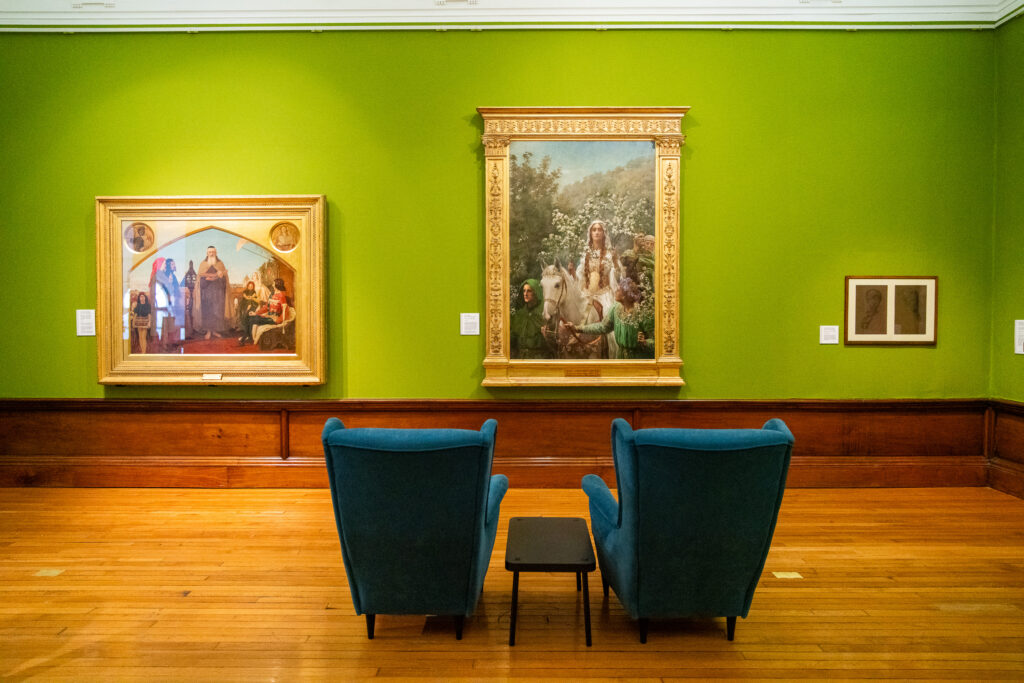
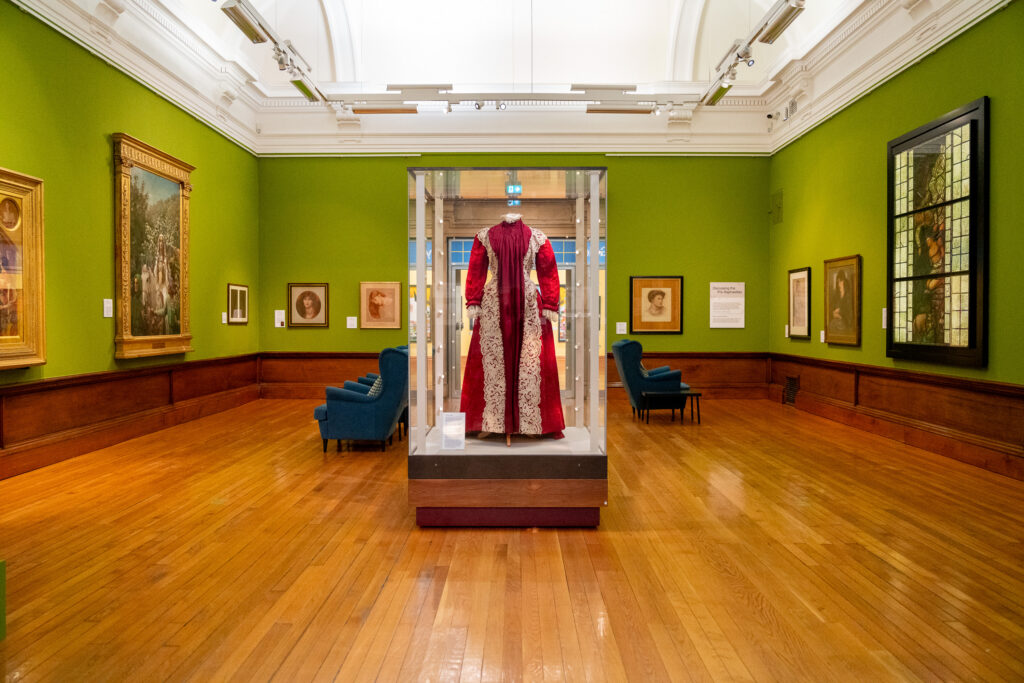
This isn’t really an exhibition – it’s a one-room, temporary display, open until 31 December, of Bradford’s ‘small but significant’ collection of Pre-Raphaelite art – but it’s still well worth a visit for aficionados of the movement. Hung in a gallery specially decorated in a shade of pea-green that sets it off very nicely, it includes just two paintings: Ford Madox Brown’s pre-Pre-Raphaelite The First Translation of the Bible into English (1847-48, reworked 1859-61) and John Collier’s post-Pre-Raphaelite Queen Guinevere’s Maying (c1897). Most of it consists of studies, produced during the half century bracketed by the paintings, and most of them are by Dante Gabriel Rossetti.
The standout exhibit is a large drawing in coloured chalks, La Donna Della Finestra – Rossetti at his weird best – which takes its subject from La Vita Nuova by Dante Alighieri. It’s characterised by what Robin Ironside described so well as the ‘deeply-lit, nether-worldly, medicated atmosphere’ that began to appear in his work after the death in 1862 of Elizabeth Siddal. This quality is particularly evident in his masterpiece, Tate Britain’s Beata Beatrix, which he completed in 1870, the same year in which he drew La Donna Della Finestra. Ironside – dope-fiend, visionary Neo-Romantic painter, and Assistant Keeper at the Tate Gallery during 1937-46 – was a pioneer of the mid-twentieth-century revival of serious interest in the Pre-Raphaelites and his book Pre-Raphaelite Painters (1948), from which the phrase comes, still merits a place on all our shelves. The red dove with the poppy in its beak in Beata Beatrix signifies the laudanum overdose that caused Lizzie’s death and, although he was at the height of his powers in 1870, Rossetti – probably already no stranger to opiates himself – was standing on a precipice from which he was about to plunge into paranoid delusion and addiction.
He had already mythologised himself and his late wife as Dante and Beatrice; now he added Jane, the wife of his friend William Morris, to the potent mix. La Donna Della Finestra shows her in the moment described in La Vita Nuova – which he had translated into English – when the grieving poet realises that he is being observed: ‘feeling this and being in dread lest any should have seen me, I lifted mine eyes to look; and then perceived a young and very beautiful lady, who was gazing upon me from a window with a gaze full of pity’.
Picture after indiscreet picture of Jane, each more self-revealing than the one before, flowed from his brush and pencil. They were brought together in an earlier exhibition, also featuring La Donna Della Finestra, called ‘Rossetti’s Obsession: Images of Jane Morris’, shown at Cartwright Hall in 2014. Writing to Theodore Watts-Dunton the year after Rossetti died, Jane told him: ‘that Gabriel was mad was but too true, no one knows that better than myself, but that his work after 1868 was worthless … I deny’.
In The Contemporary Review for October 1871, Robert Buchanan launched the attack that tipped Rossetti over the edge, finding in his work ‘weary, wasting, yet exquisite sensuality; nothing virile, nothing tender, nothing completely sane [and] a superfluity of extreme sensibility’. Buchanan was little more than an envious poetaster hiding behind a pseudonym, but we might concede the accuracy of his observation that ‘the fleshly feeling is everywhere … generally in the foreground, flushing the whole … with unhealthy rose-colour, stifling the senses with overpowering sickliness, as of too much civet’. I think some of the women in Rossetti’s paintings do convey a discomforting physicality, a feeling that one is standing too close to them in a stuffy, over-heated room, so that one begins to imagine the smell of their perfume, even of their sweat.
If Rossetti’s mature work is ‘fleshly all over’, as Buchanan suggested, and if La Donna Della Finestra has this characteristic – and in the letter quoted above Jane said that she heartily agreed ‘with those who consider the early work his best’, singling out its ‘freshness’ for praise – then ‘Pre-Raphaelites Reframed’ contains at least one very different work, and the contrast supplies the central dynamic of the display. It is almost startling, as one moves around the room, to come upon the small black chalk Study of a Head for the Virgin in ‘The Annunciation’ by Edward Burne-Jones. The huge painting for which it is a preparatory work shows the Virgin Mary absorbing the news that the angel has just given her, not looking at him, or at us, but staring thoughtfully into space. The model was Julia Stephen, who, like Jane Morris, was one of those Pre-Raphaelite super-models whose contribution to the movement we have recently come to recognise was almost as great as that of the male artists.
It was Rossetti who introduced Burne-Jones – at that time his young protégé, humble Ned Jones – to Sara Prinsep’s salon at Little Holland House in 1857. ‘You must know these people, Ned’, he told him on the way there; ‘they are remarkable people: you will see a painter there, he paints a queer sort of pictures about God and Creation’. Later, Burne-Jones was to call Mrs Prinsep ‘the nearest thing to a mother that I ever knew’. Julia was Sara’s niece, the favourite model of another aunt, the photographer Julia Margaret Cameron, and sat many times to the painter of the ‘queer sort of pictures’, George Frederick Watts. She spent much of her childhood at Little Holland House and was only a little girl when Burne-Jones first met her. By the time she posed for him in 1879 she had been widowed and remarried and was pregnant with a child who would grow up to be the Bloomsbury painter Vanessa Bell, and his work had come to be characterised by a sort of icy chastity. ‘Lust does frighten me, I must say’ he told Thomas Rooke in 1898. ‘It looks like such despair – despair of any happiness and search for it in new degradation’. It’s that look-but-don’t-touch attitude – manifest in pictures like The Golden Stairs (1880) or King Cophetua and the Beggar Maid (1884) – that distinguishes Burne-Jones’s work from Rossetti’s.
2 Responses
I workshop like to buy a poster and the catalog of “The Preraffaelites reframed”. is it possibile? Thank you.
Maria Vittoria D’Amico
Hi – We’ve sent you an email with more information, but there isn’t specifically a catalogue for this exhibition