
This has been written by Heather Millard, Community Curator, wearing her ‘Butterfield Expert’ hat – and appropriately enough for Women’s History Month gives a brief overview of some of the women in the Butterfield Family.
Please be aware that given the nature of this blog, there may be some references to pregnancy-loss & death in infancy.
She writes:
It’s easy to tell the story of the Butterfield men when the physical evidence of their impact is in front of you in Cliffe Castle itself. We also have books written by Sir Frederick Butterfield, who told us about himself, and his father – but the women in the family tended to only be small side notes
However, more recent research, enquiries and correspondence has begun to allow us to understand the women more and share some of their stories – though it’s still very much a work in progess, If you have information about any of the individuals that will add to that pool of knowledge, we will very much welcome it.
There’s several women that I’m going to mention as we we can’t do a deep dive into everything and everyone in just one blog, but I hope to provide a brief snapshot – and where possible, highlight some of our other blogs that provide some more context.
As with the men of the Butterfield family, there’s a tendency to reuse the same names – so apologies in advance for any confusion that may ensue….
First up, we have Sarah Butterfield (nee Shackelton).
Sarah Shackleton
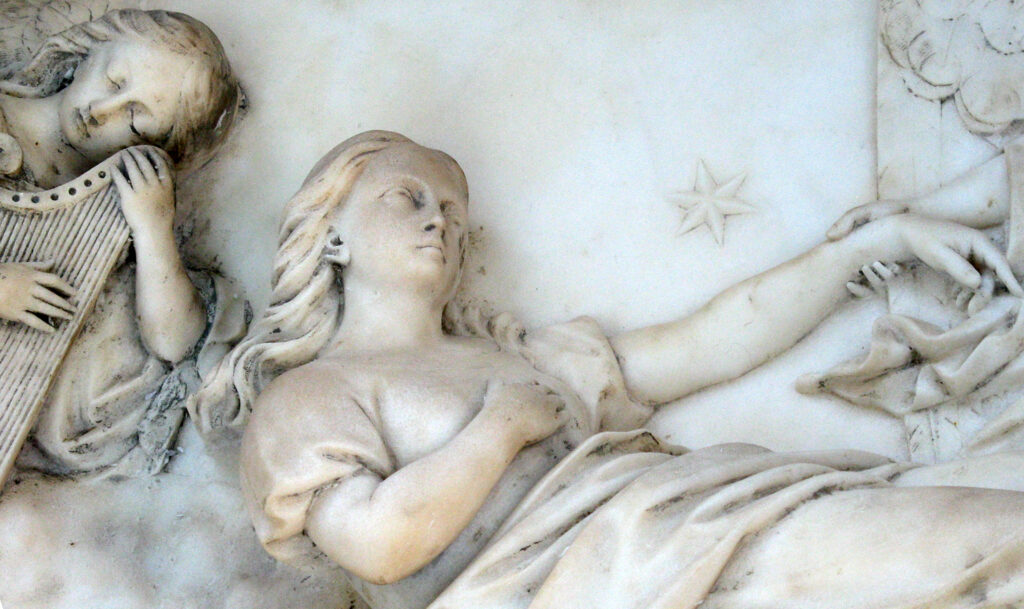
We know relatively little about Sarah. We do know that she was born in 1784 and married Isaac Butterfield in 1805 or 1806 (we’re not quite sure on that date yet). When she died in 1852, she had given birth to 7 children – 6 of whom had survived to adulthood. Her father was Richard Shackleton of Greentop, who was described by Sir Frederick Butterfield as a ‘pioneer of the cotton industry’ (but Sir Fred did like claim
When she died, the family comissioned a marble memorial stone depicting a woman with long hair. . It was orginally in the Temple Street Methodist Chapel in Keighley, but was removed when the congregation stopped worshipping there. It later turned up in the basement of a nearby house in 2018, and was gifted to us by the finder, Mr Rasool. We would like to think that it was based on family descriptions – but it’s the closest we have to an image of her
Of Sarah’s 7 children, one was a daughter – Sarah Anna (or Hannah – it varied depending on who’s talking about her!)
Sarah Anna Butterfield
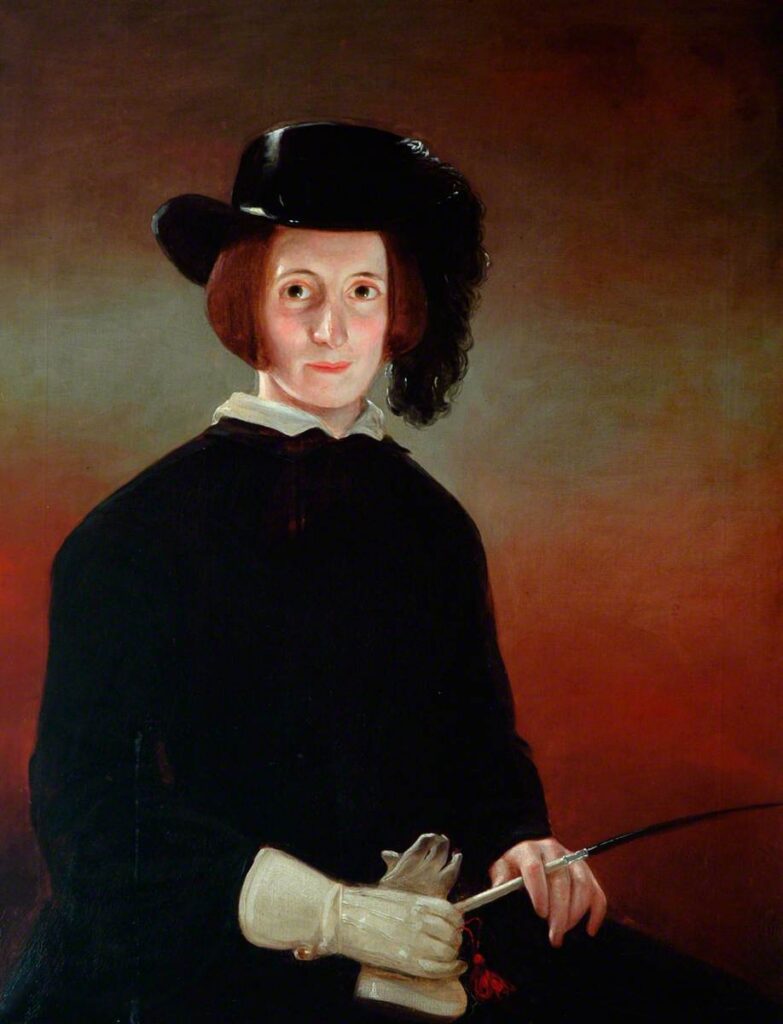
Born in 1814, Sarah-Anna was the middle child of the family. Although her brothers married, Sarah did not, supporting the wider family as they developed their businesses.
As her nephew, Sir Frederick stated
“Cliffe Castle was everything to them, so my aunt, sacrificing her own future and rejecting all offers of marriage, devoted herself to her brothers, to their comfort and general well being”1
She would become the maternal figure for several of her nieces and nephews, who would be sent to her care in Keighley in particular Sir Frederick (initially to avoid Cholera in France, but it continued after the death of his mother) and his cousin Jennie.
Portraits and photographs of Sarah-Anna show a woman who was direct and confident. The correspondence we have echoes this impression. One of my favourite snippets, which never fails to amuse me, is that where she’s simultaneously thanking her brother Henry Isaac Butterfield for sending her some new hats, whilst also complaining about the postage charges that ensued.
“I have deferred writing to you in the hope of saying something definite about my bonnet which arrived last Monday week but to my surprise the ….demanded £12-5-5 carriage from London
…opened the box and I was pleased and obliged for its contents & I thought it better to tell you the circumstance although sorry to trouble you for it is a comfort to me for you to dress me- I dislike both the trouble and thought and at the same time wish to dress as those I love like to see me-if you think proper you can tell Madame
….. I like my bonnets much but there is so much annoyance in there being forwarded that I must go elsewhere ….
ps. I am greatly obliged for the trouble you took about my bonnet”2
You can also can gain a real sense of her ‘voice’ in letter in a blog where she’s describing Christmas at Cliffe Castle in 1850. She was a woman not afraid to speak her mind!
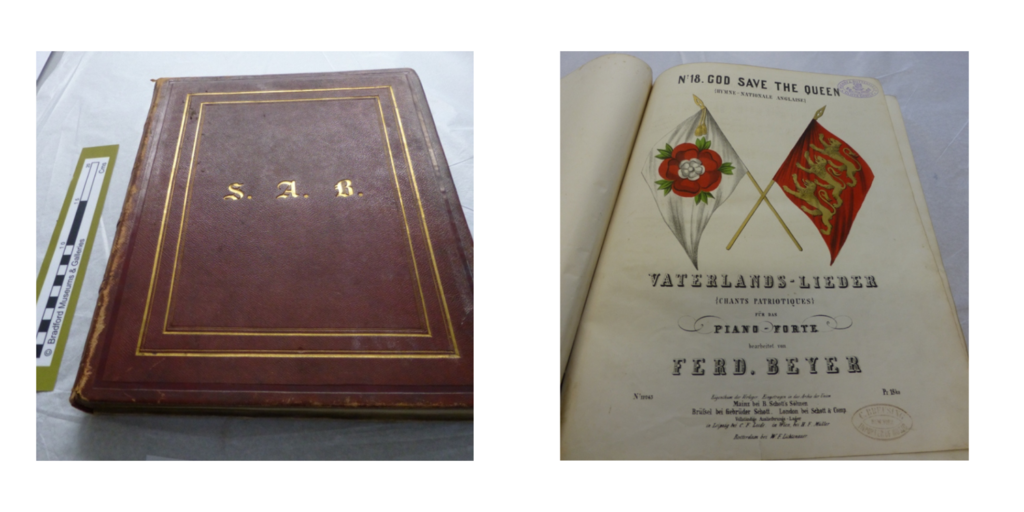
We also now have some of the sheet music she owned, which reveal a more sentimental side, with pieces like the ‘Bride of Lammermoor’ (based on Sir Walter Scott’s romantic novel) included.
Sarah traveled widely, especially after the children had grown up, and it was on one journey that she died in Palermo, on June 21st 1872. She was later interred in the family mausoleum in Utley.
Marie-Louise Roosevelt-Burke
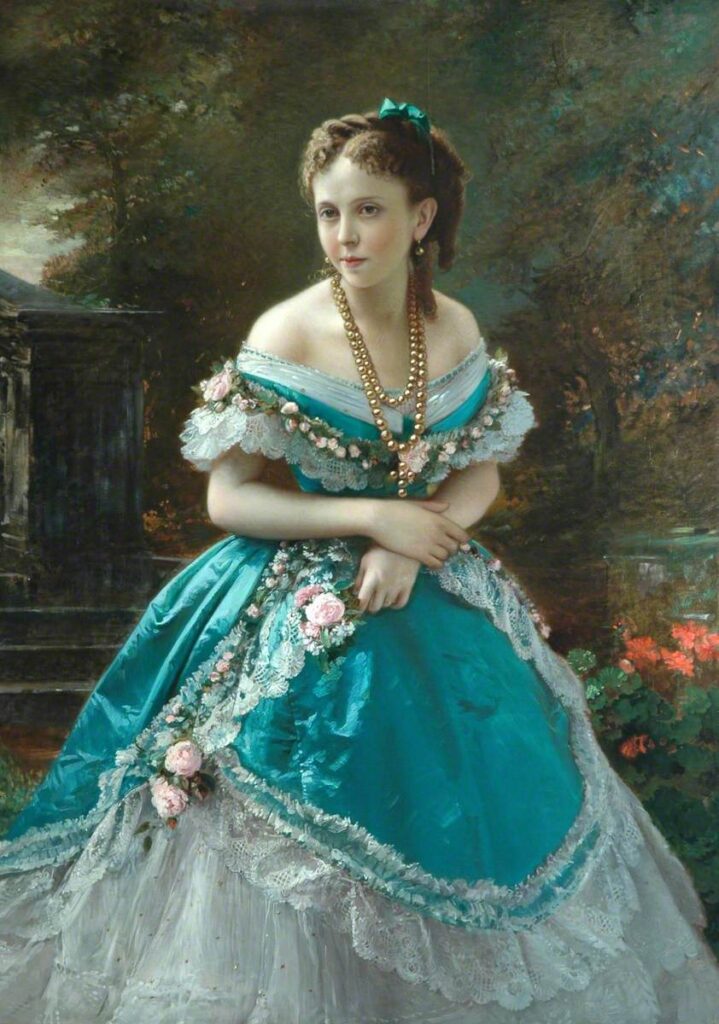
Visitors to Cliffe Castle may have seen the above portrait of Marie Louise, and wondered why there are several images of her around the castle. She was Henry-Isaac Butterfield’s wife, and when he altered and rebuilt Cliffe Hall, it was partially as a tribute to his late wife.
Marie-Louise was born in 1838 to Marie-Angelica Roosevelt (yes, one of those Roosevelts!) and the Hon. Michael Burke, and had one sister, Angela. She was described by contemporary accounts as:
“American lady whose beauty, grace and accomplishments not only gave her a prominent position in New York as a youthful belle, but as a celebrity in the court circles and with the noblesse of Paris, should be noticed among those who have added lustre to the society of this country” 3
Queens of American Society.
Living in her uncle’s house (Judge Roosevelt), Marie-Louise met her husband when he travelled to American to expand his business interests, and they married in the Catholic Cathedral in New York in 1854. I have always likened this to a reversal of the ‘Dollar Princess’ trope – in this instance, the American wife is the one with the well-known name, and her British Husband the one wishing to ally his money to an established ‘dynasty!’ Even then, prior to the presidencies of both Theodore and Franklin Delano Roosevelt, the family were well-known and well respected.
Her time in New York led to meeting Napoleon III during his stay with her Uncle, and as a result, the newly married couple moved to Paris after their marriage, when Marie-Louise was made Lady-in-Waiting to Empress Eugenie.
Her time there was successful as
Her personal beauty, her natural grace, her many accomplishments (being a fine linguist), and her exquisite taste in dress, added to her husband’s wealth and liberality, soon gave her a prominent position in the court circles of that brilliant capital. She was much noticed by the Emperor and Empress, and was always a welcome guest at the private parties given at the Tuileries, where her faultless toilette was much admired by the Empress Eugenie, herself the queen of taste and fashion.4
(So if you’ve every wondered why we have paintings of Emperor Napoleon III and Empress Eugenie on display at Cliffe Castle, that is why) .
Despite material success, Marie-Louise’s time in France involved a large amount of sadness too, with the loss of a young daughter Eugenia in 1857 when she was less than a year old and the loss of another child soon after birth referenced in correspondence between Sarah-Anna and Marie-Louise.
Her only surving child, was born in 1858 when she was 20- Frederick William Louis d’Hilliers Roosevelt Theodore Butterfield- the ‘Sir Fred’ mentioned earlier in the blog. She would send him away at the age of 5 in order to keep him safe from cholera sweeping through Paris.
Although portraits and contemporary descriptions of Marie-Louise depict her as vivacious and healthy, photographs taken seem to show a rather frail looking young woman
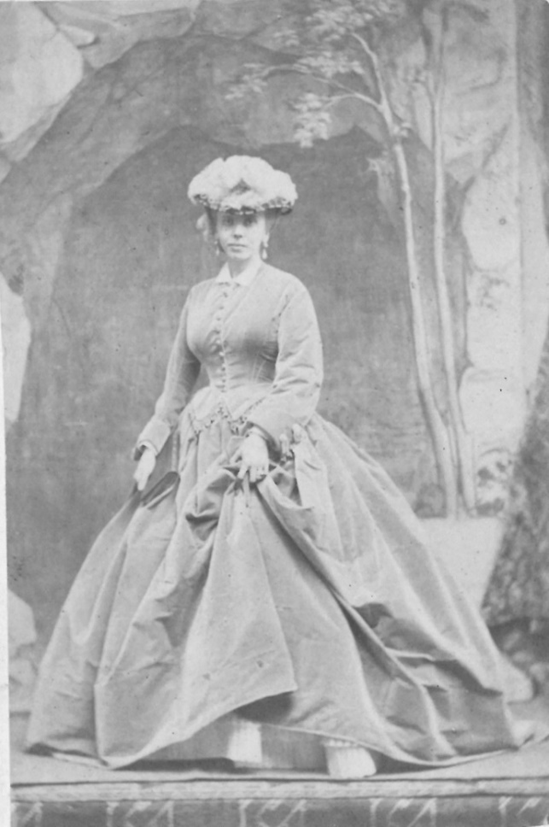
It is perhaps unsuprising then that she died at the age of 29 in Paris, in 1867.
One of the more touching items linked to her came to us as part of a family bequest in 2016, was a mourning locket owned by Henry Isaac Butterfield, containing a picture of her and a lock of her hair. (You can find out more in this blog.
I also enjoyed discovering her skill at drawing when we found a book containing schoolgirl sketchs of botanical item from her time at the Sacred Heart School in New York – though I don’t have a image of the book to share with you at present. It was a skill inherited by her grand-daughter and name-sake.
I will briefly mention two women from the next generation down, but I will save the stories of some of the other Butterfield Women – Jessie Ridgeway, Hilda Waters, Marie-Louise Pierrepont & Lady Rozelle Raynes for another day!
Jennie Butterfield
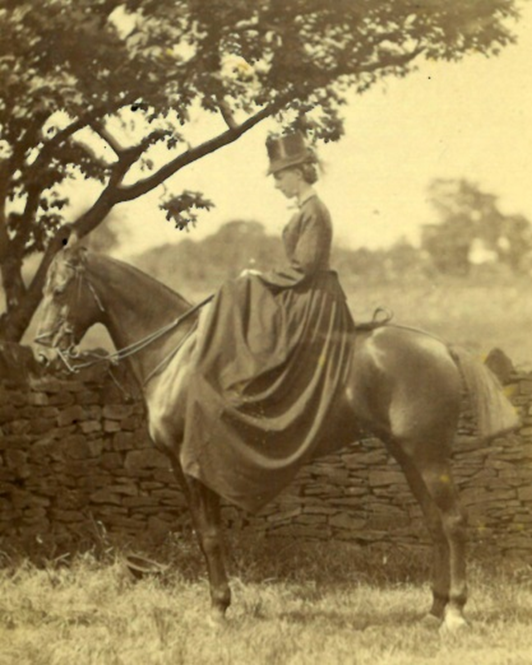
Jennie, was the niece of Sarah Anna and Henry Isaac, daughter of their older brother Richard Shackleton. We do not have many objects relating to her within our collections, though we do have this image of her, photographed somewhere in the Keighley area.
She was sent to live with Sarah-Anna after the death in 1850 (given that Jennie was born in 1850, it may well have been complications from the birth, but we do not know for definite). After Sarah Anna’s death in 1872, her uncle Henry introduced her to French Society, and ultimately, her husband – Charles Antoine Cousin de Montauban, son of the former Prime Minister of France Charles Guillaume Marie Appollinaire Antoine Cousin-Montauban.
Unfortunately, we know very little of her life after that and she died in 1878 due to complications from childbirth.
Kitty Butterfield
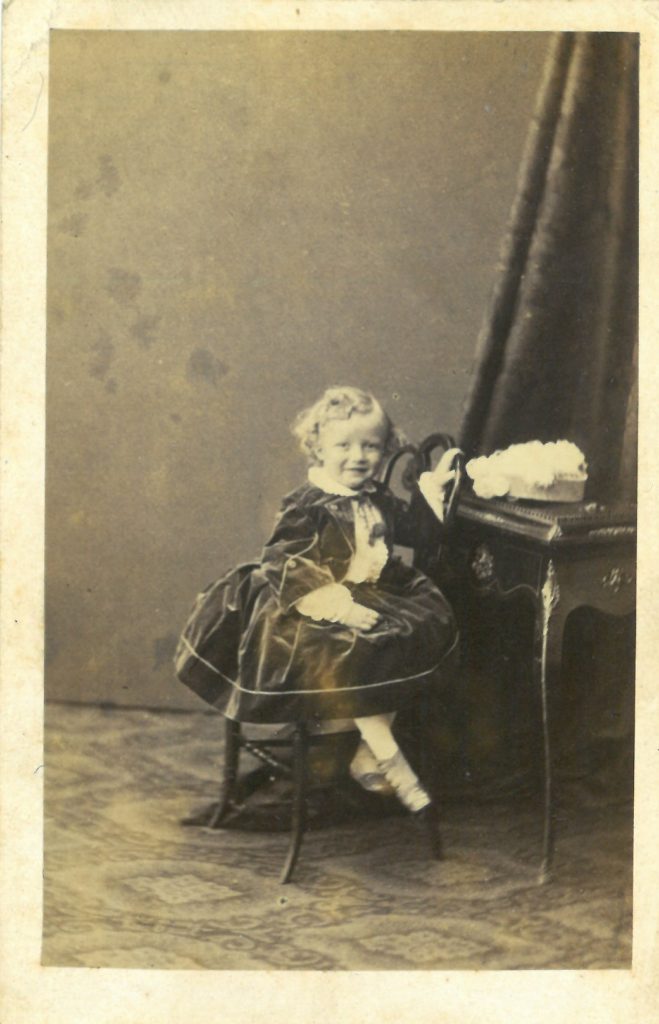
Her cousin Catherine, or Kitty, we do more about. Daughter of the youngest of the Butterfield Brothers, you can read an excellent blog already written by one of our collection volunteers here based on some of her correspondence. She’s an entertaining read!
I hope you’ve enjoyed my rather whistle-stop introduction to just some of the Butterfield Women. To find out more about the family, search our blogs using the ‘Butterfield‘ tag.
- My West Riding Experiences, FWL Butterfield ↩︎
- Sarah Anna to Henry Isaac Butterfield, Cliffe Hall, May (18??) ↩︎
- Queens of American Society, p459 Mrs Elizabeth Fries Ellet. ↩︎
- Queens of American Society, p502 Mrs Elizabeth Fries Ellet ↩︎
2 Responses
I do not want to pre-empt anything Heather might be preparing about later generations of the Butterfield women, but it might be of interest that Nottingham University published a short piece about Lady Rozelle Raynes in their “Discovery” magazine of October 2025 – https://www.nottingham.ac.uk/manuscriptsandspecialcollections/documents/discover-magazine/discover-winter-2026.pdf.
Fascinating to learn of the link between the Butterfield family and the Nottinghamshire Manvers earldom.
I’m not writing it for a while, so this article is a lovely follow on – thank you for sharing it Martin (I’ll be saving a copy, as it does give a lovely overview of a fascinating woman). It’s still a regret of mine that I never got to met her in person!
I was fascinated to find out the link myself when I started working at Cliffe Castle – having grown up in Nottinghamshire and being already familiar with Thoresby!