
November 20th to December 20th 2025 is Disability History Month. Learning and Outreach Manager Pen Foreman, a disabled person and access specialist, explores what it means to explore disability heritage in museums and why accessibility and inclusion for disabled people is a key part of their work.
I have been working at Bradford District Museums and Galleries for just over four months now, leading the brilliant team that delivers our schools, learning, communities and families programmes. One of my priorities when I started was to make sure I shared my knowledge and experience of the barriers disabled people face when visiting museums, and start building in some new ways to address those barriers.
I have both a mobility impairment and a chronic health condition, so I speak from both lived experience and expertise gained through years working on accessibility in the museums and heritage world. Over my career in museums, I have found that the stories of disabled people and the history of disability are challenging for museums to address, or not addressed at all. Disability is often described in purely medical terms, using medical devices and scientific language, not sharing the voices the people themselves. Disabled people and the barriers they face are often interpreted as inspirational life stories about overcoming adversity and their struggle as the focus, not the people themselves. This frames disabled people as being something non-disabled people should feel sorrow or pity for, that only in the act of overcoming do disabled people’s stories matter or have worth. In order to truly integrate disabled histories and heritage into museums, interpretation should be full of nuance, led by disabled people themselves.
Often, disabled people are not represented at all. At a recent online event organised by Museum Development South West, I was a speaker on a panel discussing life and career experiences of disabled people in museums.
One of the audience asked about displays and interpretations, when they don’t have any collections around disability. My co-panellist Kyle Lewis Jordan, a curator and specialist in disability in the ancient world, made an excellent point – all collections have disability heritage and history in them. You just need to know where and how to look.
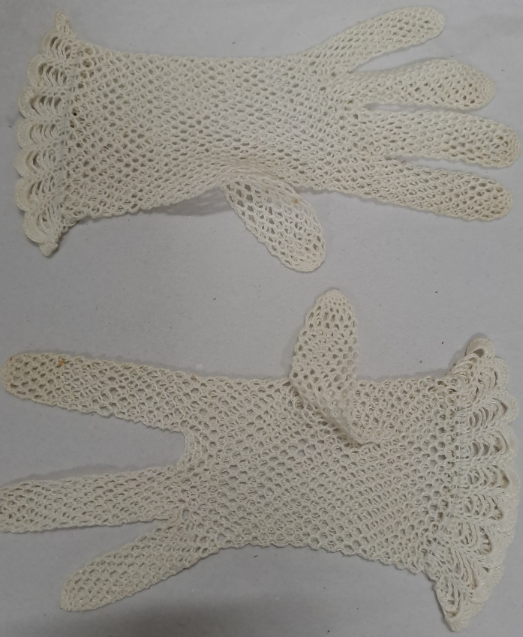
On a recent visit to our museum stores, I was shown a wonderful example of this. All objects hold stories, and these gloves tell a story about disability, fashion and adaptation. They belonged to Ada Bateson, and were made around 1928.
Ada was a mill worker at Barkerend Mills and, as was common in that industry, had an injury at work. This injury resulted in the loss of a finger when she was 18. These hand-made crochet gloves, that she specially made to have fewer fingers to fit her hand, tell the story of a young woman who wanted to be fashionable and her skill as a craftswoman, rather than the story of struggle and loss.
Much as disabled people and activists today campaign for adaptations, tools, and devices to be beautiful as well as functional to avoid a medicalised and clinical feel, the wearer of these gloves wanted to have fashionable accessories, not just functional ones. We can understand more about her style and life by seeing her as a whole person, rather than simply by thinking of her in terms of her accident and loss.
Often, disability history is not interpreted by disabled people, which can lead to nuances and the personal stories like these being lost.
Disability History Month was developed by disabled people and disabled led organisations in 2010, its aim is to
“raise awareness of the unequal position of disabled people in society and to advocate disability equality; to develop an understanding of the historical roots of this inequality; to highlight the significance of disabled people’s struggles for equality and inclusion and the ‘social model’ of disability; to publicise and argue for the implementation of the United Nations Convention of the Rights of People with Disabilities and the Equalities Act (2010).
At Bradford District Museums and Galleries, we have a collective responsibility to represent the history of disabled people, and also to make our wonderful museums and galleries accessible and inclusive for all.
As part of that, I have just launched a call out for panel members for an Access Panel for Bradford Museums and Galleries. This panel, made up of disabled, d/Deaf, and neurodivergent people, will meet to discuss and provide recommendations and advice to the Museums and Galleries, informing our planning and development of exhibitions, events, and interpretation – as well as improving our accessibility across our sites. Members will be paid for their time, in recognition of expertise via lived experience.
You can find out more, including how to apply for the panel – here: Accessibility – Bradford District Museums & Galleries